Physics Multiple Choice Questions for Medical and Engineering Entrance and AP Physics Examinations
If we did all things we are capable of, we would literally astound ourselves.
– Thomas A. Edison
Monday, November 23, 2009
EAMCET 2009 (Medical) Questions (MCQ) on Rotational Motion
Monday, May 28, 2007
A Question (MCQ) on Rolling
Here is a question which checks your understanding of basic things in angular motion and simple harmonic motion:
A solid cylinder of mass M and radius R is resting on a horizontal platform which is parallel to the XZ plane. The cylinder can rotate freely about its own axis, which is along the X-direction. The platform is given a linear simple harmonic motion of angular frequency ‘ω’ and amplitude ‘A’ in the Z-direction. If there is no slipping between the cylinder and the platform, the maximum torque acting on the cylinder is
(a) 2MR2Aω2 (b) MR2Aω2 (c) 2MRAω2
(d) MRAω2 (e) MRAω2/2
You may be remembering the expression for maximum acceleration of a simple harmonic motion: amax = ω2A
[ If you don’t remember the above expression, you may use the simplest form of simple harmonic motion of amplitude ‘A’ and angular frequency ‘ω’ and differentiate it twice:
z = A sin ωt (We write the displacement as ‘z’ since it is in the Z-direction).
a = d2z/dt2 = –ω2A sin ωt
Therefore, the maximum acceleration is ω2A].
The maximum angular acceleration (αmax) of the cylinder is given by
αmax = amax/R = ω2A/R.
The maximum torque (τmax) on the cylinder is given by
τmax = αmaxI, where ‘I’ is the moment of inertia of the cylinder about its own axis (which is equal to MR2/2).
Therefore, maximum torque τmax = (ω2A/R) (MR2/2) = MRAω2/2
You will find an interesting MCQ on rolling at physicsplus: MCQ on Rolling Bodies
Monday, April 16, 2007
Two Multiple Choice Questions on Moment of Inertia
(a) 1 (b) 2 (c) 3 (d) 4 (e) 5
The moment of inertia of the rods AB and CB about an axis perpendicular to the plane of the triangle and passing through the corner B is ML2/3 + ML2/3 = 2 ML2/3 where M is the mass of each rod and L is the length. [Note that the moment of inertia of a thin rod about a normal axis through its centre of mass is ML2/12 and hence its moment of inertia about a normal axis through one end, according to the theorem of parallel axes, is (ML2/12) + M(L/2)2 = ML2/3].
The moment of inertia of the rod AC about the axis through B is
ML2/12 + M[(√3/2)L]2 = ML2/12 + 3 ML2/4 = 5ML2/6, in accordance with the theorem of parallel axes. [The distance of AC from B is L sin60° = (√3/2)L].
The moment of inertia of the entire triangle about the axis through B is the sum of the moments of inertia of the three rods and is equal to 2 ML2/3 +5ML2/6 = 9ML2/6 = 3ML2/2. Substituting for M (=2kg) and L (=1m), we obtain the answer as 3 kgm2.
Friday, October 13, 2006
Rotational Motion – Rolling bodies
The ring and the pipe have k2/R2 = 1, since I=MR2 = Mk2. If you find the values of k2/R2 in the case of differently shaped rolling bodies, you will realize that it is minimum (2/5) for the solid sphere and maximum (equal to1) for a thin ring and a thin pipe. Since (k2/R2) appears in the denominator in the expression for ‘a’, the acceleration down the plane is maximum in the case of a solid sphere and minimum in the case of a ring or a pipe. So the solid sphere arrives at the bottom first and the ring and the pipe arrive last.
You should remember that the moment of inertia of a disk (and that of a solid cylinder) about its rolling axis is ½ MR2 and that of a hollow sphere is (2/3) MR2
It is interesting to note that all solid spheres will arrive at the bottom together, irrespective of their mass and size. Similarly, all thin rings and thin pipes will arrive together, irrespective of their mass and size. Generally speaking, bodies of a given shape will arrive together, irrespective of their mass and size.
Now, consider the following M.C.Q.:
(a) v (b) v√2 (c) 2v (d) v/√2 (e) v/2
Note that if a body is to roll along any surface, friction is necessary and that is why the plane is said to be made rough in the problem. On a smooth plane, the body will slide down with acceleration gsinθ and will reach the bottom with a velocity ‘v’ given by v2 = 0 + 2gsinθ×s, as given by the usual equation of linear motion, v2 = u2 + 2as.
Therefore, v = √(2sgsinθ).
On rolling, the acceleration down the plane is gsinθ/[1 + (k2/R2)] = ½ gsinθ since k2/R2 = 1 for a ring. Therefore the velocity (v1) on reaching the bottom is given by v12 = 0 + 2×½ gsinθ×s
Therefore, v1 = √(sgsinθ) = v/√2 [Option (d)].
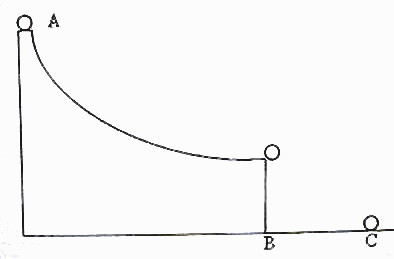
When the sphere is released, it rolls down (without slipping) along the track and after leaving the lower end of the track, it moves like a projectile and lands at the point C. The horizontal distance BC is(a) R√[(20/7)gh(H-h)] (b) √[(20/7)gh(H-h)] (c) √[(10/7)gh(H-h)]
(d) √[(20/7)h(H-h)] (e) √[(5/7)h(H-h)]
The loss of potential energy by the sphere on rolling down along the track is equal to the gain of kinetic energy (both translational and rotational) so that
Mg(H-h) = ½ Mv2 + ½ I ω2 where M is the mass, ‘v’ is the linear velocity, ‘ω’ is the angular velocity and ‘I’ is the moment of inertia of the sphere, which is (2/5)MR2. Substituting for ω = v/R, we obtain v = √[(10/7)g(H-h)]. This is the horizontal velocity of the sphere at the lower end of the track. Since its height at the lower end of the track is ‘h’, the time taken to reach the ground from there is t = √(2h/g). Note that we obtain this time by considering the vertical motion of the sphere and using the equation, h = 0 + ½ gt2. The horizontal distance BC = vt = √[(20/7)h(H-h)]. So, (d) is the correct option. Note that this contains neither R nor g.
The following question is a conventional type which you will get in your class examinations as well as in entrance tests:
(a) √(2gh) (b) √(4gh/3) (c) √(3gh/4) (d) √(2gh/3) (e) √(3gh/2)
Equating the gravitational potential energy of the cylinder at the top of the plane to the sum of the translational and rotational kinetic energies at the bottom, we have,Mgh = ½ Mv2 + ½ I ω2 = ½ Mv2 + ½ ×½ MR2 × (v/R)2 = (3/4)Mv2, from which v = √(4gh/3).
A spherical ball rolls on a table without slipping. The fraction of its total energy which is associated with rotational motion is
(a) 3/5 9b) 2/3 (c) 2/5 (d) 3/7 (e) 2/7
The rolling ball has translational and rotational kinetic energies giving it total kinetic energy equal to ½ Mv2 + ½ I ω2 = ½ Mv2 + ½ ×(2/5)MR2 × (v/R))2 =½ Mv2 + (1/5)Mv2 = (7/10)Mv2.
The rotational kinetic energy is (1/5)Mv2 and the total kinetic energy is (7/10)Mv2. The required ratio is therefore (1/5) / (7/10) which is 2/7 [Option (e)].
Saturday, August 19, 2006
Questions on Rotational motion
(1) If the radius of the earth is changed to 1/√3 times the present value, the duration of the day (in hours) will be
(a) 72 (b) 41.6 (c) 24 (d) 12 (e) 8
This question is set to check your understanding of the law of conservation of angular momentum: I1ω1= I2ω2 where I1and I2 are the moments of inertia and ω1 and ω2 are the angular velocities of the earth before and after the contraction respectively. Substituting for I1 (= 2MR2/5) and I2 [= 2M (R2/3)/5] we obtain ω2 = 3ω1. Since the angular velocity changes to 3 times the initial value, the spin period of the earth (T= 2π/ω) changes two one-third of the initial value. So, the duration of the day will become 24/3 = 8 hours.
Questions of this type are often found in Medical and Engineering Entrance Test papers. Generally, if the radius of the earth becomes ‘n’ times the present value, the duration of the day becomes 24n2 hours. Remember this equation and write the answer in no time!
(2) If your weight while standing on the earth’s surface at the equator is to become zero, the earth should spin at nearly ------ times the present speed.
(a) 12 (b) 14 (c) 17 (d) 24 (e) 37
This is a simple question. If you are to become weightless due to the spin of the earth, the gravitational pull on you is to be balanced by the centrifugal force so that, mg = mRω2. From this ω=√(g/R) and the spin period T=2π/ω=2π√(R/g). On substituting for R = 6400 km and g = 9.8ms-2, the period works out to be 84.6 minutes. This is one-seventeenth the present period of 24 hours. So, the earth should spin at 17 times the present speed. [Option (c)].
Thursday, July 13, 2006
Let us consider a couple of questions involving rigid body rotation.
(1) A meter scale is held vertically with one end on the floor and is allowed to fall. Assuming that the end on the floor does not slip, what will be the linear velocity of the other end when it strikes the floor?
(a) 2.7m/s (b) 3.1m/s (c) 5.4m/s (d) 9.8m/s (e) 11.2m/s
When the meter scale is allowed to fall, its gravitational potential energy gets converted into rotational kinetic energy so that we have
mgl/2 = ½ I ω 2 where ‘l’ is the length(1metre for a metre scale), ‘m’ is the mass, ‘ω’ is the angular velocity and ‘I’ is the moment of inertia of the scale. l/2 appears in the potential energy expression since the centre of gravity of the scale is initially at a height l/2. You should note that the moment of inertia of the scale is about the end in contact with the floor and is equal to ml2/3.
From the above equation, ω =√(3g/l).
The linear velocity of the feree end of the scale = ωl = √(3gl). On substituting for l(=1) and g(=9.8) the linear velocity is 5.4m/s [Option (c)].
(2) An impulsive force F acting for a short time interval ∆t is applied at one end of a thin uniform bar of mass M and length L, in a direction perpendicular to the lengthof the bar. The angular velocity with which the bar will rotate is
(a) F∆t/4ML (b) F∆t/2ML (c)2F∆t/ML (d) 4F∆t/ML (e) 6F∆t/ML
The impulse received by the bar is F∆t which is equal to the linear momentum supplied. The bar will rotate about its centre of mass. The ‘lever arm’ for the angular momentum is L/2 so that we have, (L/2)F∆t = Iω = ML2ω /12. So, ω =6F∆t/ML